Mindful Re-Presentations: Towards Greater Harmony and Belonging
Mindful Representations brings together Family Constellations, mindfulness, systemic awareness, solution-focused practice, and reflective observation to explore the relationships, emotional dynamics, and inherited stories that quietly shape our lives.
Developed through long-term engagement with Family Constellation work, the approach places particular emphasis on grounded awareness, emotional discernment, reflective restraint, and respectful integration.
While many approaches focus primarily on the individual, Mindful Representations also considers the wider systems we are part of, including families, relationships, organisations, communities, cultures, and our relationship with the natural world.
Through mindful exploration, individuals and groups can begin to recognise unhelpful patterns, deepen understanding, strengthen belonging, cultivate resilience, and develop healthier and more workable ways of relating to themselves, others, and the wider systems of which they are a part.
Mindful Representations are explored experientially through workshops and training programs that invite participants to investigate the systems they live within and are shaped by, including families, workplaces, communities, and their relationship with the natural world.
In these workshops, a skilled facilitator guides participants through a collaborative process that can bring greater awareness to relational patterns, emotional dynamics, and the ways people become entangled in unhelpful roles, loyalties, or inherited burdens.
The process aims to support deeper understanding, meaningful connection, and healthier ways of relating within ourselves and the wider systems we belong to, while allowing greater room for individuality, differentiation, and authentic participation within those relationships.
Mindful Representations brings together mindfulness, systemic awareness, and reflective observation to explore the relational patterns, emotional dynamics, and inherited stories that quietly shape our lives.
Developed through long-term engagement with Family Constellation work, the approach places particular emphasis on grounded awareness, emotional discernment, reflective restraint, and respectful integration.
Rather than rushing toward conclusions or dramatic interpretations, the process encourages a slower and more thoughtful exploration of what emerges within individuals, relationships, families, organisations, and the wider systems we belong to.
We’re all woven into complex networks of connection, and sometimes those threads become tangled through family history, emotional inheritance, and long-standing ways of relating that often operate outside awareness. The process not only fosters more compassionate, resilient relationships, it also builds your ability to hold clear boundaries and stay centred in the midst of emotional crosswinds.
At its heart, Mindful Re-Presentations is about finding that sweet spot between growing as an individual and staying connected to others, so we can move through the world with more ease, balance, and belonging.
The Benefits of Participating in a Mindful Representation Workshop
The workshops often leave participants with a deeper felt sense of themselves, their relationships, and the patterns moving through the systems they belong to. As a representative or as an observer in the “holding circle,” you’ll gain a deeper understanding of different perspectives and how human relationships and systems can become more workable, resilient, and connected
By actively participating, you’ll also strengthen skills in reflective observation, emotional awareness, perspective-taking, and navigating complex group dynamics, while fostering empathy, supporting the repair of strained relationships, and developing a broader appreciation of how relationships and systems interact.
Participating in a Mindful Re-Presentations workshop can open space for personal growth, deeper understanding, and more balanced ways of relating within the wider systems we are part of.
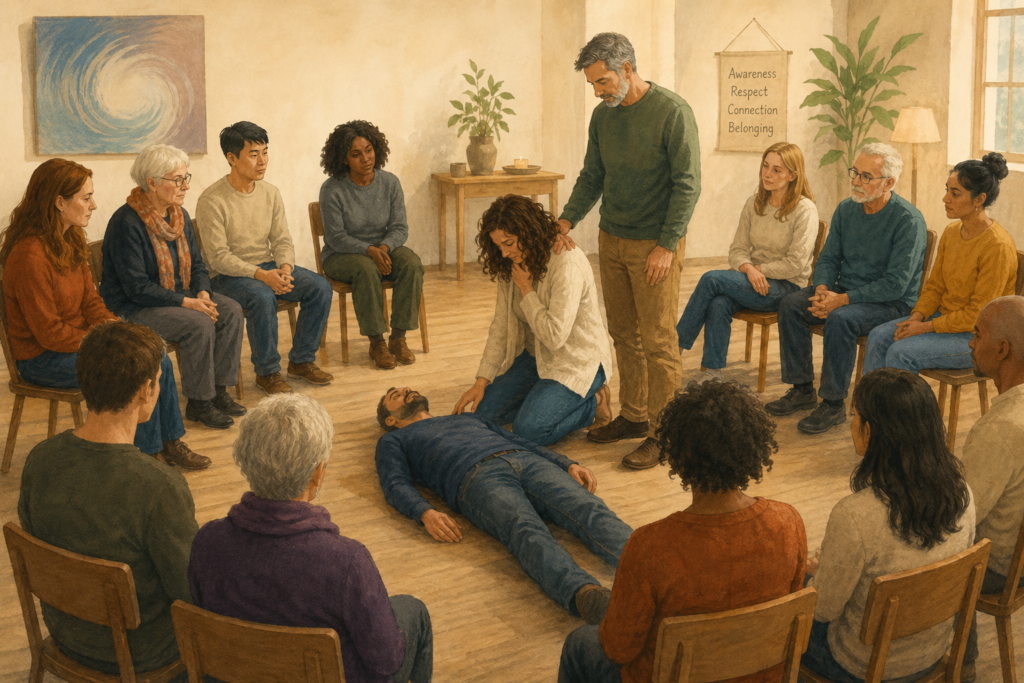
How does Mindful Representations differ from traditional Family Constellation work? One important difference is the deliberate integration of mindfulness practice into the process.
Mindful Representations integrate mindfulness with the Family Constellation approach, creating an experiential process that combines relational awareness with mindful presence.
Family Constellations developed through influences from Family Therapy, Gestalt Therapy, phenomenological approaches, and broader observations about relationships, belonging, and family systems. A key figure in its development was the German psychotherapist Bert Hellinger. His work drew attention to themes such as family loyalty, inclusion, and the impact of wider relational systems. While his contributions helped shape the field, some of his ideas and interpretations have also generated significant debate and criticism.
Hellinger placed strong emphasis on the importance of presence and careful observation within the process. However, while presence was considered central, there was less emphasis on structured methods for deliberately cultivating these capacities.
This is where mindfulness enters the picture. Rooted in contemplative traditions and increasingly integrated into contemporary psychological practice, mindfulness strengthens our capacity to remain present, reduce distraction, and approach experience with openness and curiosity.
Mindfulness and contemplative practices have also been proposed as ways of strengthening phenomenological observation and present-moment awareness (Varela, Thompson & Rosch, 2017). In Mindful Representations, mindfulness training is therefore used to support facilitator presence, strengthen reflective observation, and deepen participant engagement within the workshop process.
Moreover, Mindful Representations may also deepen participants’ mindfulness practice by helping integrate mindful awareness into relationships and everyday life.
Varela, F. J., E. Thompson and E. Rosch (2017). The embodied mind, revised edition: Cognitive science and human experience, MIT press.
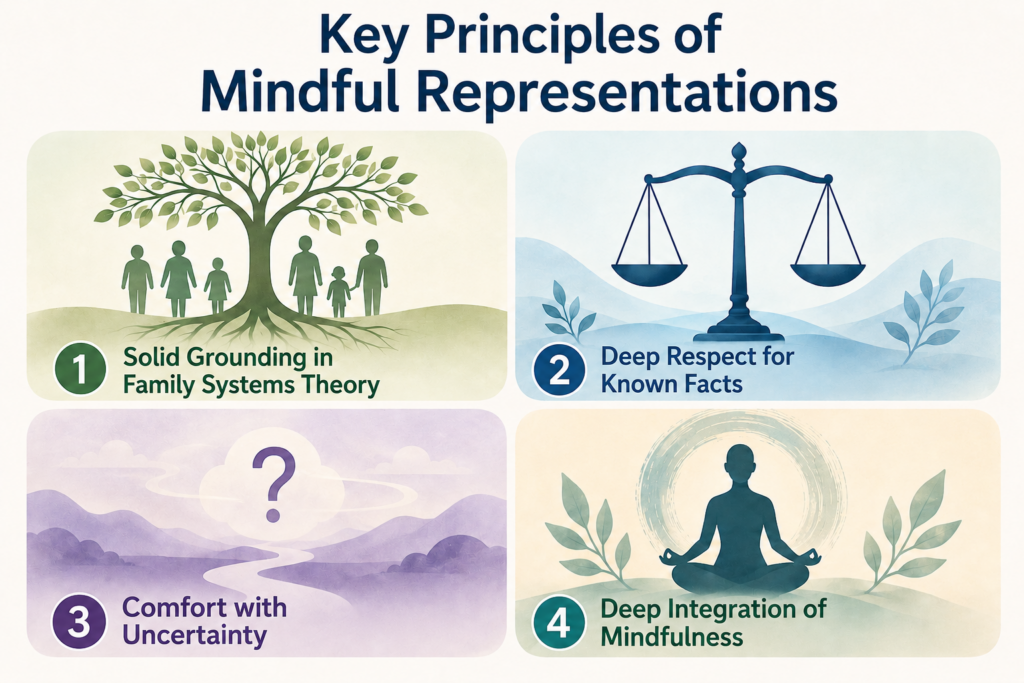
What sets Mindful Representations Apart.
1. A Solid Grounding in Family Systems Theory
This provides a strong foundation for understanding the dynamics and complexities of family interactions, providing a strong foundation for the work. This then enables us to find a place of respectful inclusion for everyone whilst still maintaining healthy boundaries.
2. A Deep Respect for Known Facts
This keeps us from being swayed by magical thinking or wishful interpretations. Any intuitive insights or emerging understandings are explored in relation to known facts and context.
3. Being Comfortable with Uncertainty
When facts remain uncertain or elusive, we embrace the humility of not knowing. Rather than forcing a hasty conclusion, we allow space for clarity to emerge in its own time.
4.Deep integration of mindfulness.
By combining mindfulness with these principles, facilitators and participants stay grounded, engaged, and open during representations. This method strengthens your mindfulness practice, helping you integrate it more deeply into your everyday life and relationships.
The Workshop Process: Mindful Exploration in Action
In these workshops, participants embark on a transformative journey designed to restore harmony and support within their family systems. Here’s a simplified guide to how it unfolds:
1. Setting the Stage
The group gathers in a circle. Then the facilitator helps the group settle into a mindful and attentive space.
2. Preparing for a Representation
One person (the “seeker”) shares their concern with the facilitator. Key individuals from the seeker’s life are chosen to be represented by other participants.
3. Representation Setup
The seeker arranges the representatives within the circle. The representatives know little about the people they are portraying. Despite this, participants often notice behaviours, emotions, or relational dynamics that feel personally meaningful or resonate with aspects of the seeker’s broader relational experience.
4. Facilitator’s Role
With mindfulness and deep respect for the known facts about the family’s history, the facilitator guides the process. One of the distinctive strengths of this approach is its ability to bring relational and intergenerational patterns into an experiential setting where they can become more visible and emotionally accessible than through discussion alone.
5. Navigating the Representation
As the process unfolds, we may add more representatives. They often represent ancestors, forgotten, or excluded family members. This can include those who have died young, been disgraced, or been excluded like ex-partners or biological parents of adopted children. A skilful practitioner engages with this process in a mindful and respectful way, allowing previously hidden tensions, emotions, and relational dynamics to emerge more fully into awareness where they can be explored with greater understanding and care.
6. Moving Toward Healing and Reconciliation
Sometimes a simple phrase, image, gesture, or moment of recognition within the process can touch something difficult to fully capture in ordinary language, continuing to resonate and unfold long after the workshop itself has ended.
7. Lasting Impact
The seeker often leaves carrying emotionally resonant images, phrases, or experiences that continue unfolding inwardly over time. These may contribute to positive changes in their relationships and a stronger sense of belonging. Over time, many report experiencing lasting shifts in how they relate to themselves and others. At times, participants notice shifts in how they understand or engage with important relationships and wider social systems. This can open possibilities for healthier and more balanced ways of relating over time.
8. Broader Impact
Engaging in this mindful, grounded process brings personal clarity for everyone involved in the workshop. Moreover it naturally leads participants to adopt a broader, more respectful perspective. It opens us up to a deep empathy for others that can be quite moving. Most participants describe the experience as deeply meaningful, rewarding, and practically useful in their everyday lives and relationships.
For a more detailed version of what happens in a Mindful Representations Click here
A one-day workshop will usually include about 4-6 full mindful representations and about four pieces of formal mindfulness work. One of the pieces of mindfulness work usually uses the process of representation to give participants a deeper mindfulness experience.