Most of us watch genealogy television for the stories.
We enjoy the unexpected discoveries, the faded photographs, the old letters and the remarkable twists that connect ordinary people with extraordinary moments in history. One episode may uncover a forgotten war hero, another a transported convict, while another reveals a family secret that has remained hidden for generations.
They are fascinating programs in their own right, but if we watch them a little differently, they can become something much more than entertainment. Instead of simply following another family’s history, we gradually find ourselves drawn into another person’s world. Before we quite realise it, we are viewing their life with curiosity, imagination and respect, while remaining grounded in the historical evidence. Before long, we discover that we are not just learning about the past. We are quietly developing a way of seeing people that lies at the heart of Mindful Representations.
One of the most valuable capacities we can cultivate in this way is the ability to imaginatively inhabit another person’s experience without losing our grounding in reality.
Historical records provide the facts. Birth certificates, military records, passenger lists, census documents and family letters tell us what happened. Once those facts have been established, our imagination naturally begins asking a different question.
What might it actually have been like to live that life?
We might wonder what it was like to leave Ireland during the Great Famine, knowing that you might never see your family again, or to arrive in Australia in chains as a transported convict. We may find ourselves asking what it was like to conceal a pregnancy in a society where shame could shape the course of an entire life, or to flee war carrying little more than hope and determination.
These questions are not about inventing stories. They are about allowing documented facts to become living human experience. As we begin asking them, history slowly comes alive. It is no longer simply a collection of names and dates, but a world inhabited by real people doing the best they could within the opportunities and constraints of their own time.
🌿 Pause for Reflection
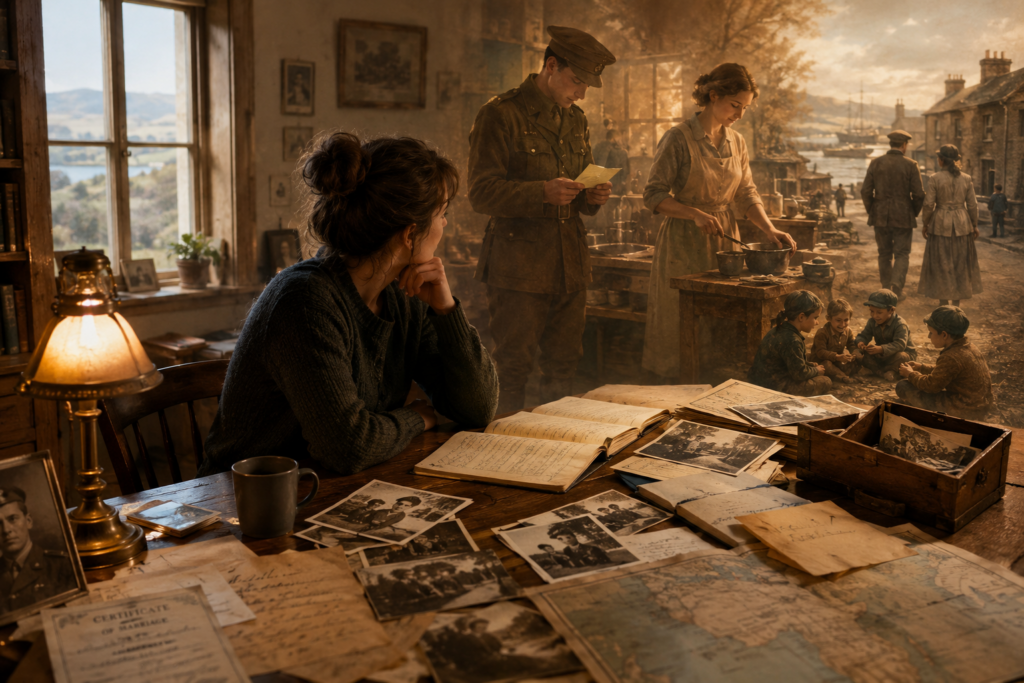
Imagine discovering an old photograph tucked away in a family album. There is no name on the back, no surviving story—just a face looking back at you across a century. It would be easy to invent a life for that person. It would be equally easy to dismiss them as someone of little importance.
Curiosity invites another response. It simply asks, “Who were you?” Perhaps the beginning of empathy is not finding the answer, but learning to linger with the question.
Mindfulness and Genealogy Television
Genealogy television offers far more than fascinating family history. When watched with curiosity and mindful awareness, these programs become practical exercises in developing historical empathy and a richer understanding of human lives.
We usually think of mindfulness as paying attention to our own thoughts, emotions and bodily sensations. Here, however, we gradually extend that same open-hearted awareness into the lives of other people. As we become curious about their experiences, we also remain aware of our own. We notice what moves us, what surprises us and what assumptions we bring to the stories unfolding before us.
Genealogy television is not unique in this respect. A beautifully written novel, a thoughtful film or a well-crafted drama can all invite us into another person’s world. What makes genealogy particularly valuable is that our imagination remains anchored in historical evidence. The documented facts provide a framework within which thoughtful enquiry can flourish without drifting into speculation.
Watching in this way transforms what might otherwise be simple entertainment into an opportunity to cultivate curiosity, empathy and a deeper appreciation of other people’s lives. Almost without noticing it, we begin practising the very qualities that mindfulness encourages: openness, careful observation and the willingness to remain with experience before rushing to conclusions.
As we continue watching, we begin to recognise two complementary forms of empathy. The first is intellectual empathy: understanding another person’s world through facts, historical context and disciplined imagination. The second is emotional empathy: becoming aware of our own emotional responses as we enter that person’s world through mindful awareness.
Together, they enrich one another. Historical understanding deepens emotional connection, while emotional awareness reminds us that history is never just about facts. It is always about people.
The Historian, The Storyteller and the Scientist
As we become more absorbed in these stories, we may begin to notice that several different ways of understanding are quietly working together within us.
Part of us wants to establish the historical facts as accurately as possible. This is the historian within us, patiently gathering evidence before reaching conclusions.
At the same time, another part is trying to imagine what life might actually have felt like for the people whose stories are emerging from old records and forgotten photographs. This is the storyteller. Its role is not to invent events but to allow documented history to become lived human experience.
Alongside both sits the scientist, gently asking whether our understanding remains faithful to the evidence. Are there alternative explanations? Have we made assumptions too quickly? What still remains uncertain?
Mindful Representations invites us to integrate these three ways of seeing. The historian keeps us grounded in reality. The storyteller reminds us that facts alone rarely capture the richness of a human life. The scientist encourages humility by recognising that genuine curiosity is always willing to live alongside uncertainty.
The relationship between curiosity, uncertainty and wise judgement is explored further in Wisdom Beyond False Certainty – A Sufi Story About Wisdom, Curiosity and Critical Thinking.
When these three ways of seeing begin working together, something rather remarkable happens. We are no longer simply watching history unfold. We begin entering it with curiosity, imagination and respect.
Understanding another person’s life requires more than evidence alone.
It requires imagination disciplined by evidence, curiosity tempered by humility and a willingness to remain open to what we have not yet understood.
🤔 Thought Experiment
Imagine three people sitting together watching the same genealogy program. One becomes absorbed in the records, dates and documents, carefully piecing together the historical facts. Another finds their attention drawn beyond the evidence, wondering what those people might have felt, feared or hoped for. The third listens quietly before asking, “How certain can we really be?”
Each notices something important.
Now imagine what would happen if any one of them quietly left the room. What would the others no longer be able to see?
Perhaps wisdom is less about deciding which voice is right than learning when each deserves to be heard.

Encountering Unknown Ancestors
One of the most fascinating aspects of these programs is watching what happens when participants encounter an ancestor they have never known, perhaps someone who lived more than a century before they were born. Sometimes the emotional response is immediate and unexpectedly powerful. There may be tears, a long silence, or simply an expression of surprise that they should feel so deeply moved by the story of someone who, only moments earlier, they did not even know existed.
Their response naturally raises a series of questions for us as viewers.
Why this particular ancestor? Why this story rather than another? What is it that has touched them so deeply? Why should someone feel such a profound connection with a person they have only just discovered?
The programs rarely attempt to answer those questions directly, and I think that is one of their strengths. Rather than rushing towards an explanation, they leave room for curiosity. They remind us that not every meaningful human experience needs to be immediately understood.
Instead, they quietly invite us to stay with the mystery a little longer.
Mindful Representations invites us to take that curiosity one gentle step further by asking another question.
How is this history still alive?
The question is not asked because we assume every emotional response reflects a transgenerational process, nor because we are searching for hidden causes. It is asked because it encourages us to look more carefully. It encourages us to remain open to possibilities while staying firmly grounded in careful observation and the available evidence.
In many ways, this balance between curiosity and disciplined enquiry lies at the heart of Mindful Representations.

Historical Empathy
As we become more comfortable entering another person’s world with curiosity and imagination, another capacity begins to develop almost unnoticed. That is historical empathy, and these programs also quietly stretch that capacity.
Every generation inhabits a world that is, in some respects, profoundly different from our own. The opportunities available to people, the dangers they faced, the expectations placed upon them and even the values by which they lived were shaped by the time and culture into which they were born.
It is remarkably easy to judge the decisions of previous generations through the lens of our own values, assumptions and expectations. It is much harder—and ultimately much more rewarding—to ask what those decisions looked like from within the world as they experienced it.
Understanding does not require us to approve of every action, nor does it diminish personal responsibility. Rather, it encourages us to understand before we judge.
As our historical understanding deepens, our perspective begins to widen. The curiosity that mindfulness initially directs towards our own thoughts and feelings gradually extends further beyond ourselves. We become curious about another person’s experience, then about the family to which they belonged, and gradually about the larger historical forces that shaped that family’s life. We begin to appreciate the influence of war, migration, poverty, colonisation, religious persecution and changing social values, recognising that people rarely live isolated lives. They are participants in histories far larger than themselves.
As our historical understanding deepens, historical empathy gradually gives rise to a broader perspective. We begin to appreciate not only the individual before us, but also the family, culture and historical forces that helped shape their life. From this wider perspective, compassion often arises naturally.
We recognise that every life has been shaped by circumstances, opportunities and limitations that are only partly visible to us. That broader understanding does not remove accountability, but it often softens judgement and opens the possibility of deeper understanding and, sometimes, reconciliation. Far from diminishing discernment, it refines it. We become more attentive to complexity and nuance, yet less inclined to make simple judgements about people whose lives we can now see more fully.
🌿 Pause for Reflection
Think of someone from history—or even from your own family—whose choices you have always found difficult to understand.
Without excusing or condemning those choices, what might become visible if you became curious about the world they inhabited rather than judging it only through your own?
Sometimes understanding begins when judgement pauses long enough for curiosity to ask another question.
Two Programs Worth Watching
Two series stand out as particularly rich resources for this kind of viewing.
Who Do You Think You Are?
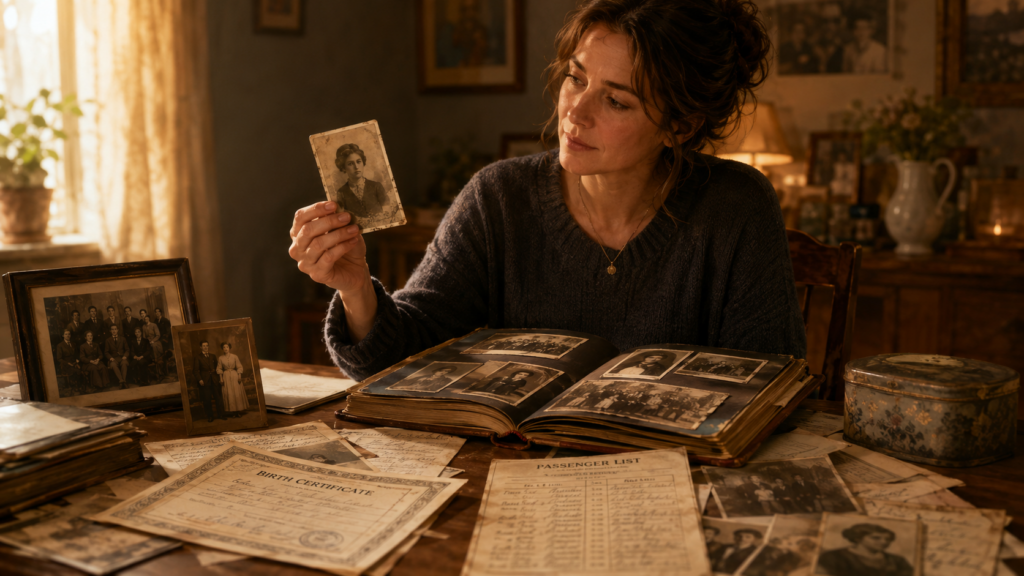
Perhaps the best-known example is Who Do You Think You Are? which beautifully demonstrates the power of historical facts to reshape a person’s understanding of themselves. Time and again we watch participants discover birth certificates, military records, census documents, passenger lists or forgotten letters that fundamentally alter the story they have always believed about their family.
Notice the moment when information becomes experience. A document is read. There is often a pause, a deep breath or an unexpected silence before the emotional significance of the discovery begins to register. Something shifts. History has ceased to be simply an interesting fact and has become personally meaningful.
That also reminds us of something that is easy to overlook. Facts matter. They anchor us in reality and help prevent us from constructing stories that may be emotionally compelling but are unsupported by evidence. For anyone interested in Mindful Representations, this balance between disciplined enquiry and open curiosity is an invaluable lesson.
Every Family Has a Secret
A second series, Every Family Has a Secret, explores similar themes through the lives of ordinary families. Hidden adoptions, wartime experiences, migration, long-buried secrets and forgotten relationships all become part of the unfolding story.
What I particularly appreciate is the way the program reveals the effects of exclusion. As forgotten people are gradually restored to the family narrative, participants often experience a complex mixture of grief, sadness, relief, compassion and renewed belonging. Once again, we are reminded that understanding does not simply come from discovering facts. It also grows from allowing those facts to find their rightful place within a family’s story.
Neither series is perfect. Television naturally compresses complicated lives into narratives that fit within an hour, and real life is rarely so tidy. Yet if you watch with curiosity rather than simply for entertainment, both series become opportunities to practise a different way of seeing. Almost without noticing it, entertainment becomes education, and education becomes a way of cultivating curiosity, empathy and understanding.
Looking a Little Longer
The next time you watch one of these programs, try a small experiment.
Instead of asking only, “What happened?”, also ask yourself, “What might it have been like to live that life?”
Notice your own emotional responses as the story unfolds. Observe how your understanding changes as new facts emerge. Pay attention to moments that unexpectedly move you, and simply become curious about them. You don’t need to explain everything immediately. Sometimes the most valuable thing we can do is remain with a question a little longer before reaching for an answer.
Curiosity often sees more than certainty allows.
You may gradually discover that these programs are quietly developing capacities that reach far beyond an interest in family history. They invite us to cultivate historical empathy, mindful awareness, disciplined imagination and a broader appreciation of the complex forces that shape human lives.
Perhaps most importantly, they encourage us to see people less as isolated individuals and more as participants in stories that extend across generations.
That subtle shift in perspective changes more than our understanding of history. It changes the way we begin to see one another. It doesn’t remove responsibility for our actions, but it often brings greater understanding, deeper compassion and, occasionally, the possibility of reconciliation.
💭 One Final Question
Imagine someone exploring your own family history a hundred years from now.
What would you hope they would understand before judging the lives they discovered? What parts of your own world would you hope they would take the time to see before reaching conclusions?
Perhaps that question has something to teach us about the way we look at the lives of others today.
Final Reflections
One of the things I value most about genealogy television is that it reminds us that every person has a story, and every story belongs within a larger story.
The longer we watch in this way, the more our perspective quietly expands. We begin with an individual, but our attention gradually widens to include the family to which they belong, the historical forces that shaped that family, and the wider culture within which those events unfolded. Before long, we realise that no life can be fully understood in isolation because every person is participating in relationships and histories that extend far beyond themselves.
Every culture is shaped by the history through which it has travelled, just as every individual is shaped by the relationships, opportunities and challenges that have influenced their own life.
Mindfulness teaches us to pay attention to our own experience with openness and curiosity. Genealogy television quietly offers an opportunity to extend that same quality of attention into the lives of others. As our awareness gradually widens, so too does our capacity for empathy, compassion and understanding.
Perhaps that is why I find myself returning to these programs. They begin by telling stories about the past, yet almost unnoticed, they teach us a way of seeing the present.
In learning to see the lives of others a little more clearly, we may also begin to understand our own a little more deeply. Perhaps that is one of the greatest gifts genealogy television has to offer
Continue Exploring
If you’d like to learn more about the ideas introduced here, you may also enjoy: